Thursday, May 1, 2014

Our Fairy Tale Plays


Aladdin and the Magic Pickle Jar


Claynocchio


Clinky Clanky Tenbo

Jack and the Giant Sunflower
Prince Frog


Wednesday, March 12, 2014

Diary of a Worm...Tub

This week we received a container full of worms.  We prepared our worm tub by tearing up newspaper, adding old fruit and vegetable scraps, and topping it off with a little soil.  The purpose of housing these wriggly friends?  We are learning about how organisms interact with their environment, by observing our worms and how they transform the lovely habitat we made for them into rich compost.

So far, we have begun to build our schema about worms (their bodies, what they eat, where they live, and what they do) by reading fiction for facts.  That is, we are reading some great fictional stories that also can teach us about worms!  It is fun to see students arrive at the realization that fiction is not just for fun- some fiction can be informative!  We have already learned some fascinating wormlore, and dispelled some worm myths...  Did you know:


  • Worms don't have eyes.
  • Worms eat rocks!  Inside a worm's stomach, the rocks help to grind up food, and then the rocks are passed in worm's poop, which is called a cast.
  • Worms have five pairs of hearts.
  • If you cut a worm in half, the pieces will not grow into two new worms.  That's a myth!

We will continue to study worms next week, as we (patiently) let the worms do their work in our tubs.

We will continue after break to broaden this understanding of organisms interacting with their environment by researching some other animals that change or alter the space in which they live.  For example, beavers which create dams that alter the course of rivers.  A great home conversation, especially as the weather warms and changes from mammals, birds, even plants and bugs, become evident, would be to look around your yard or the park for evidence of animal or plant changes.  Do seedlings pop up in cracks in the sidewalk?  Can you see holes made by chipmunks or woodpeckers?

We will keep you up to date on the fun changes we see in our worm tub over the next month or two!  Happy worm watching!

Fairy Tales & Other Learning

This week, we kicked off a huge fairy tale unit in second grade!  During this unit, we will be reading and analyzing fairy tales.  We have been reading, watching, and listening to many fairy tales to really build our schema about how these stories are written.  In particular, we are investigating fairy tales for common elements.
Fairy Tale Elements

In addition to providing great opportunities for retelling, summarizing, and identifying the main idea of stories, this unit teaches students to analyze story plot, and to compare two versions of the same story written by different authors.

After we explore several different versions of Cinderella from diverse cultures and perspectives, we will compare their settings, characters, and beginning, middle, and end for differences and similarities.  Then, students will read and analyze several versions of other common fairy tales in book clubs.  They will present their findings to the class, and write an opinion telling us which version they thought was the best.

Finally, students will get an opportunity to apply these understandings, writing their very own fractured fairy tales.  Our final products will display our knowledge of fairy tale elements, story structure, character development, and writing craft!  This is such a great literacy project to end the year.

Other Learning

In math, we are building off our two digit addition knowledge to solve three digit addition (with and without regrouping) using decomposing. Stay tuned for an update when we post Educreations showing off our new skills!

In addition, we are continuing to build our comfort with time and money.  In second grade, students should be able to tell time to the nearest five minutes, and solve simple word problems involving change.

In science, we began a unit exploring how organisms interact with the environment with our own Worm Tub!  Stay tuned for a post on what we are learning through these wriggly creatures.

In Writing, we are beginning to write our Expert Projects (see previous posts).

In Word Study, we are concluding our parts of speech unit with Adverbs! Next week, we will review nouns, proper nouns, pronouns, verbs, adjectives, and adverbs.  Mad Libs, anyone?

Monday, March 3, 2014

Marble Track Educreations & Other Learning

Check out our Educreation Presentations we made today to explain how our marble tracks work, and some of the learning behind this project:

Brady & Josh
Katie & Kailey
Sam & Olivia
Sophie & Brittany
Connor, Dylan, Isaaq, and Jordan
Dominic, Evan, Emily & Owen
Aidan, Kristen & Cassie
Emery, Hailey, & Kayleigh

We did a wonderful job using Educreations to publish our projects digitally!

Other Learning

We are also beginning to learn a 2-digit subtraction strategy that using decomposing to explain the process of regrouping more clearly before we learn the "traditional" algorithm after break.  Stay tuned for a post demonstrating how to solve the way we solve!

In word study, we are finishing our parts of speech study with nouns, adjectives, and now verbs.  Next week we will learn adverbs.

In writing, we are wrapping up our Book Reviews (opinion writing) by recording them using photobooth (Anyone remember Reading Rainbow? That's our theme!) Next, we will practice informational writing with our Expert Projects.

In preparation for expert projects, we are studying informational texts this week, keep a close eye on organization.  Second graders are expected to identify not only the main idea of an informational text, but the topic or main idea of specific paragraphs within a text.  Identifying the topic of each paragraph helps us to further see the connection between each section, and how those details contribute to the whole meaning of the text.


Friday, February 28, 2014

Marble Tracks... Completed!

We worked hard the past two weeks to apply what we learned about forces and motion to our Marble Tracks!  Check out our completed tracks!


Thank you for all the donations of cardboard rolls and masking tape!  See a previous post, here, to see what we learned while making our tracks!

Thursday, February 27, 2014

Two Digit Addition Strategies

In second grade, students are expected to solve two digit addition and subtraction problems. This week, we have been focusing on adding up to four two-digit numbers using place value and properties of addition.  So what exactly does that mean?


  • Place value strategies: Splitting a number into tens and ones (decomposing) and adding the tens together, the ones together, and then adding your two sums to get your total.  In later grades, this is called partial sums.  Many of you have seen this strategy on our Educreations.
  • Properties of addition: We use the commutative and associative properties of addition (though not by name,) to decide what order to add two or more numbers.  We worked on many addition shortcuts at the beginning of the year, so when adding the numbers  
6 + 4 + 6

students might decide to add 6 + 4 first, because those are making ten pairs, OR add 6 + 6 first, because those are doubles students should have memorized.  This freedom allows students to answer problems more quickly by avoiding math facts that are more difficult.

Take a look at our recent Educreations to see how we are doing solving four two-digit addition problems.  One of the biggest obstacles students face is not solving a multi-step addition problem, but getting their basic math facts right!

Wednesday, February 26, 2014

Informational Writing

We are gearing up for our Expert Projects- projects where students write about a topic they know a lot about!  This is a great unit for students to practice their informational writing skills.  In second grade, students are expected to write informational paragraphs introducing the topic, with facts and details (at least 3!) and with a concluding statement or section.  Here is our anchor chart to help us remember how to write a paragraph!


In addition to practicing our informational writing skills, we will be revising and editing our work (with peer and teacher assistance) and focusing on our writing goals during these projects.  We can't wait to show off all of our expertise!


Parent Experts!

Thank you to all our parents who volunteered to come in and share their expertise with us! We learned so much and had a ton of fun.  Here are some priceless pictures from the last weeks.

Mrs. Bohn teaches us yoga!


Senor Sturtz taught us spanish!

Mrs. Martin-Shaheen taught us how to sew!

Mr. Wallen taught us about playing the trumpet!

Mr. Willis teaches us about being a Marine


These presentations helped us realize that everybody can be an expert about something! Thank you to our parent experts for taking the time to come in and share their expertise!

Thursday, February 20, 2014

Teaching Independence

One of the most important parts of my job as a second grade teacher is teaching independence to 7 and 8 year-olds.  This can be difficult at times, but independence is such an important virtue.  Here are some ways you can help bridge the home-school gap and help your child learn independence this year:

  • When your child asks for help spelling a word, don't give it to them right away!  Instead, ask "What sounds do you hear in the word?  Do you hear any words you know how to spell inside that word?  Where might you find that word in our house?"  Encourage your child to build strategies for spelling words that don't rely on you- but rather on their own initiative and problem-solving.  If they spell the word close to correctly (or even in a way that makes sense phonetically) praise their attempt.  You don't even always have to correct their mistakes, which can negate the effort they put into spelling the word independently.
  • That goes for any school work! If a child needs help on math, ask "What would you do first? Can you start the problem? Which part is tricky for you?"  The more you ask your child to explore the roadblock s/he is encountering, the more you encourage your child to reflect on the difficulties they are facing, and find a way around it.  In fact, usually this method will help students realize they CAN solve the problem on their own!
  • If a student is frustrated or upset, I always ask what the problem is, and then ask the student "How could you go about solving this problem?"  Asking the student to take ownership for tackling the problem instills a sense of efficacy in the student.  The last thing I want to do is take over and solve the problem for them, unless teacher intervention really is necessary.  Let them try two or three attempts before jumping in and suggesting your own. And always make your child do most of the work to solve.
  • Wait for your child to ASK for help before you jump in.  And that doesn't mean stating that they are stuck.  When students TELL me "I don't know how to sign onto Scootpad" I might respond, "hmmm... that is a problem.  Well, thanks for sharing that with me."  I encourage students to learn that I will always help them find a solution if they ASK for it.  Besides just being polite to ask, it lets students know that I will not swoop in and solve all their problems, that I expect them to (and believe they can) try to solve the problem on their own.
  • Let your child be the authority on school! If you have a question about your child's classwork or assignments, ask your child first. This lets them feel a sense of responsibility for assignments or information that is communicated.  If they are unsure, a probing question such as "Well, how do you normally do this?" or "What would your teacher tell you if you asked this question?" can draw out more information.  Then let your child know you appreciate his or her aid in solving your problem!
  • Let them fail.  It's okay if your child tries a strategy that you know is doomed to fail.  As the saying goes, we learn more from our mistakes. Protecting them from failure costs them valuable learning experiences-at an age where mistakes are not all that fatal.  Once they fail, tell them "That was a good try," and give a few suggestions.
These are just a few tips to teach independence.  Remember, you can't just expect your child to be an independent learner... but you also can't just do it all for them!  Teaching independence is huge at this age, and any work you put in now will have a huge impact on their future learning!

Great Questions for Independence:
  • How would you normally do this?  What would you do first?  
  • Can you try a strategy, and then ask for help if you still need it?
  • What can you do to help solve this problem on your own?
  • What parts are hard?  What parts are easy?

Tuesday, February 11, 2014

Student Led Conferences & Educreations

Thank you to all our families who participated in Student-Led conferences!  We practiced so hard and did some really great reflection that will help to steer our growth goals as we head into the second half of the year.  Whether at home or at school, I had many great compliments on how well the conferences went.  Thank you for giving your student this opportunity to share the wonderful things he or she is doing in class.

Many parents remarked on how neat the Educreations presentations were.  Educreations is a great app you can download on your Ipad to create whiteboard presentations with voice-overs.  We have been using them to show what we know how to do in math and in reading.

As we continue to use this app to record ourselves, you can check out your child's work by going to www.educreations.com and asking your child to sign in using his or her lunch number and the password hte105.

Thank you for making this such a valuable reflection and learning opportunity for our class!

1,000 cm Marble Tracks & Learning Points

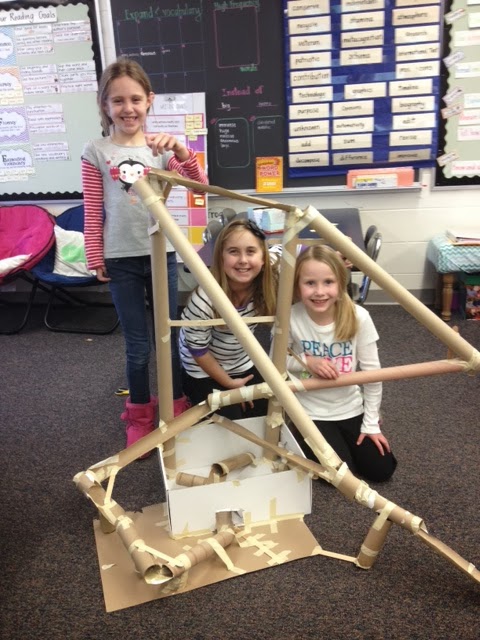
We have officially begun building our marble tracks!  After working hard these past few weeks to learn force concepts and measurement skills, our class was so excited to start.  Thank you for sending in the wrapping paper rolls, paper towel rolls, masking tape, and other supplies.  Below is a picture of our first day- not as messy as I had thought we would be.

Our class begins the great marble track project!

This project is a great culmination to our learning.  In second grade, we learn that a force is a push or a pull, and explore how an object starts and stops moving, changes direction, and changes speed.  We explore the concepts of gravity, friction, and momentum and their practical application, but are not responsible for remembering the terms and their definitions.  All of these concepts are applied to our marble tracks.

In measurement, we studied the difference between the us standard units (inch, foot, yard) and metric units (millimeter, centimeter, meter) and developed a comfort distinguishing between them.  We established reference points to help us remember about how long each unit is.  Finally, we practiced using a ruler correctly to measure in both inches and centimeters.  We also used this as an opportunity to problem solve- what if an object is longer than our ruler? How might we find out how long it is?

In addition to providing us an opportunity to practice the skills and apply the concepts we have been learning in math and science, these projects are a great illustration of the design process and trial and error.  The amount of failure we encounter with these projects is staggering- every new twist or turn or ramp has to be tested, redesigned, tested again, and on and on.  I love seeing how resilient and motivated the students are to continue trying again and again.  They also must make their track structurally sound- sturdy enough to move every day.  Finally, students are learning valuable lessons on teamwork.

We hope to finish out tracks by Friday, February 21st, and I will keep families informed of a "publishing" celebration for these projects :)

Thursday, December 5, 2013

Problem Solving


In math, we have been working on solving addition and subtraction stories that include two digit addition or subtraction.  This is extra tricky, because the problems require reading skills, critical thinking skills (as we decide what kind of math is needed, and what the "unknown" is,) and our math skills!  We know lots of ways to solve two digit addition problems, and are working on learning two digit subtraction problems.  We recorded our thinking in our Math Journals.


Mystery Reader

 Check out our Mystery Reader from today!

Tuesday, November 26, 2013

Video Games & Technology

 We have been learning about how technology changes over time during our unit on video games.  We spent several weeks learning about past video games, and created several timelines to show how video game consoles, controllers, and graphics have changed over time.  Despite our lack of schema about video games from the old days (and with some important input from parents and even Mrs. Willis,) we were able to explore some key differences between past video game technology and current gaming systems.
Our last timeline explored how graphics have changed over time through Mario, one of the oldest video game characters.

Students noticed many changes in computer graphics.
Mr. Mcmann, a parent from Mrs. Hite's class, came in to share his knowledge of video games on Tuesday.
Next week, we will be looking at where video games might be going in the future.  Stay tuned for some of our predictions- today's second graders could be tomorrow's gaming innovators!

Thursday, November 21, 2013

Mystery Readers

Check out our latest Mystery Readers:
Mrs. Minogue 

Mrs. Johnson

Monday, November 11, 2013

Happy Veteran's Day

Happy Veteran's Day from Miss Miller's class! In addition to writing letters to veterans and participating in our Veteran's Day assembly, second grade had the opportunity to video chat with Lcpl. Willis (AKA Miss Miller's fiance) live from Camp Lejeune, North Carolina, today!  We asked some great questions about Veteran's Day, life in the military, and what it is like to be a United States Marine.  Thank you to Mr. Willis for taking time out of his day to chat!
Students were able to speak to Lcpl. Willis and hear about life in the military.

We came up with some great questions!


Add caption


Thursday, October 31, 2013

Big Cheese and Halloween!

Check out our latest Big Cheese, Mrs. Mamula!  She read Halloween stories to us today.


And check out our adorable Halloween costumes.


Tuesday, October 29, 2013

Big Cheese

Check out our latest Mystery Reader!  We love to have readers in the class, and students are so excited to see people they know walk through those doors.

Earth Buddies

The past few weeks in science have been all about Conservation and Recycling.  We began by building our schema about the two words by looking through books and inferring their meaning.  We learned a lot just by looking through books, a great illustration of how we can teach ourselves!


Then we jigsawed reading books about being Earth Buddies- that means that we split up into pairs and we each read one of the short informational books.  Then we rearranged our groups so that we could share out our learning with students who read different books, combining our knowledge to build up our schemas even more!


We are getting really good at making inferences while reading.  We know that you need your schema and evidence from the text to make an inference, and that good readers infer answers to questions that cannot be found in the text.  Our schema is what we already know about a topic, and we use our schema every time we begin to learn something new, and add to our schema while we learn.  A great book we read to talk about inferring is Seven Blind Mice. 


 Mrs. Parker-Jones came in today to show us how to use some new features on Pixie to prepare us to create our own Earth Buddy Presentations.  


We made our presentations in the production room, and shared them with other students in the school. Let's see if Miss Miller can get our presentation on our blog to share!

Thursday, October 17, 2013

EB Fundraiser and Pumpkin Raffle

As you know, we have been working hard to raise money for EB, which affects a student in our classroom.   A child born with Epidermolysis Bullosa (EB) has a deficiency of one of several proteins that anchor the skin to the body. One such protein is C7—an important form of collagen. Without enough of these proteins, the skin tears and pulls away from body easily, causing serious wounds and recurrent blistering (www.childrenscancer.org/puck/research.html).   When we heard that there was already a runner in the Columbus Marathon raising money for this cause, we knew we wanted to get involved! 


Our class prepares for our fundraiser!
I am so proud of how hard our class worked to set up this bake sale and pumpkin raffle, start to finish!  We not only came up with the idea, but wrote letters to other classrooms, made announcements to the whole school, donated our baked goods, and even worked at the Bake Sale and Raffle Ticket stand.  The first day alone, our pumpkins drew in over 150 raffle tickets, and we sold as many baked goods!


HTE staff decorated pumpkins for our Pumpkin Raffle
I want to thank our generous families who donated baked goods, our wonderful volunteers who worked at the booths, and our HTE staff who decorated pumpkins for our raffle (and they looked amazing!).  I also want to thank my caring and supportive group of students this year, to whom I credit the success of our fundraiser.
Students from Room 105 worked the Raffle and Bake Sale tables both days!
I am proud to announce that we raised $880.00 for EB.  The proceeds (through PUCK) go to support EB research at being done at the University of Minnesota. The research includes understanding animal models to find what the stem cell population is that makes skin and to figure out how to isolate it from human marrow. Also to do the clinical trials and to rebuild the immune system in children with EB and make blood and skin forming stem cells that are normal from EB patients.  Find out more at www.childrenscancer.org/puck/research.html.

Again, thank you all for your generous support!